
- English
- Español
- Português
- русский
- Français
- 日本語
- Deutsch
- tiếng Việt
- Italiano
- Nederlands
- ภาษาไทย
- Polski
- 한국어
- Svenska
- magyar
- Malay
- বাংলা ভাষার
- Dansk
- Suomi
- हिन्दी
- Pilipino
- Türkçe
- Gaeilge
- العربية
- Indonesia
- Norsk
- تمل
- český
- ελληνικά
- український
- Javanese
- فارسی
- தமிழ்
- తెలుగు
- नेपाली
- Burmese
- български
- ລາວ
- Latine
- Қазақша
- Euskal
- Azərbaycan
- Slovenský jazyk
- Македонски
- Lietuvos
- Eesti Keel
- Română
- Slovenski
- मराठी
- Srpski језик
Waterproof Duffel Bag Manufacturing Process
Sealock manufactures waterproof duffel bags for OEM and wholesale buyers at factories in China and Vietnam, and the process rests on a constraint most buyers never hear about. High-frequency welding — the technology that makes a bag genuinely waterproof — works against a flat base plate and is therefore best at producing flat seams. A duffel is a three-dimensional vessel. Reconciling those two facts is what duffel manufacturing actually is, and it explains the tooling costs, the lead times, and why some designs quote easily while others do not.
1. Company and Production Base
Sealock (YiFuLong Outdoor Gear Co., Ltd.) has built welded waterproof bags for over 20 years, producing for international outdoor and marine brands including OSPREY, Helly Hansen, West Marine, and CHUMS.
- Established: 2003
- Facilities: Dongguan, China | Ho Chi Minh City, Vietnam — either origin available on any model
- Certifications: ISO 9001, BSCI, SMETA, HIGG, GRS, SCAN
- Terms: MOQ 300 pcs per model, samples 7–15 days, bulk 30–45 days, FOB Guangdong
2. Why Welded Construction Is the Starting Point
The alternative to welding is stitching a seam and covering the needle holes with tape. Under pressure the difference is measurable: in factory hydrostatic testing, sewn-and-taped seams on standard bag material begin leaking at low pressure, while high-frequency welded seams hold substantially higher before failing. Tape also lifts over time with flexing, heat, and abrasion, whereas a welded bond does not — the molecular fusion is often stronger than the parent material itself.
That is the reason a waterproof duffel is welded rather than sewn, and it is also the reason its manufacturing is constrained by what welding equipment can physically do.
3. Translating a Three-Dimensional Bag Into a Flat Weld Pattern
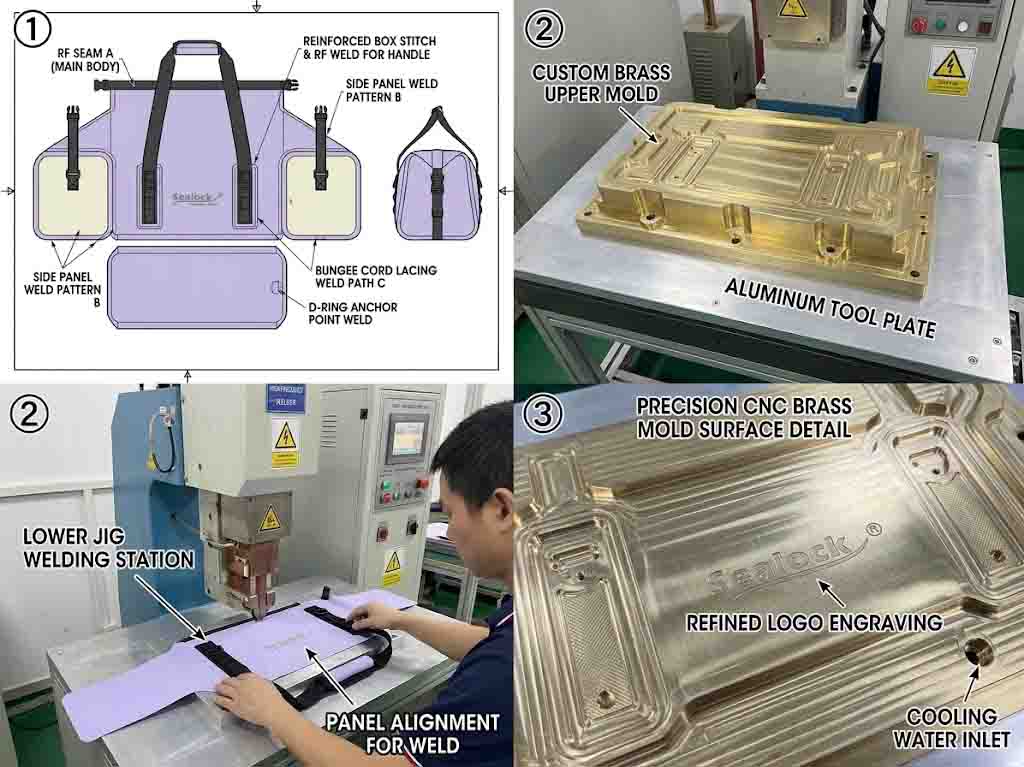
RF welding holds the material still between an upper die and a lower plate — the fabric does not move through the machine. That makes it excellent at flat seams and awkward at curved, closed forms. Three-dimensional dies, contoured base plates, and vacuum fixtures that hold panels in position do exist, but they are costly, which is why welded-bag design has always favoured shapes that can be built with reasonable tooling rather than shapes that look clever on a rendering.
So the first engineering step is not cutting or welding — it is translating the bag's geometry into a precise two-dimensional weld pattern before production starts. Every seam becomes a flat operation performed at a specific stage, and the bag becomes three-dimensional only through the order in which those flat welds are executed. A design that cannot be decomposed this way either needs expensive dedicated tooling or needs redesigning.
4. Tooling: Custom Copper Dies
Each weld pattern requires its own custom-machined electrode. Typical construction is a brass or copper upper die mounted to an aluminium tool and jig plate, working against a lower weld nest — machined smooth and to tight tolerance, because surface imperfections and dimensional drift both translate directly into weld defects.
Two commercial realities follow, and reputable factories state them rather than hide them. Tooling is quoted separately from unit price, and it adds lead time before mass production can begin. More importantly, tooling is designed for repetition rather than for one good sample: the question is not whether a die can produce one correct bag, but whether it can produce many thousands at the same quality, which is why serious tooling development takes time before testable parts even exist.
The development workflow follows a fixed sequence: CAD review of the design, tooling quotation, sample die fabrication, first-article sample, then final revisions before release to production. Buyers commissioning a new duffel silhouette should schedule against that sequence, as covered in the guide to OEM duffel factory customization.
5. Sequence: Why the Order Cannot Be Reversed
Because each weld is a flat operation, the assembly order determines whether the bag can be built at all — and on a waterproof product it also determines whether it seals. The governing rules:
- All structural stitching happens before the waterproof seal exists. Handle anchors, strap patches, and base reinforcement are attached to flat panels first, so no needle ever passes through a finished waterproof membrane. Anything added afterwards is welded onto reinforcement patches instead.
- Branding goes on flat panels. Logos are applied while the panel is still accessible and lies flat under the press.
- Sub-assemblies are completed and inspected before the body closes. Once panels are joined, an internal defect is effectively unreachable.
- Panels are welded from the most accessible seam to the least. The final closing weld has the least room for tooling, so it is planned first and executed last.
Reversing any of these does not merely reduce quality; it usually makes the remaining operations physically impossible on the tooling available. The underlying welding physics is set out in the manufacturing process from cutting to RF welding.
6. The Three Hardest Joins on a Duffel
- Corners and base junctions. Flat seams are the easy case. A duffel is essentially a box or cylinder, so it concentrates corner welds and thick multi-layer junctions where panels meet — and it carries its whole load on the base. These are where leakage risk concentrates and where seam overlap design, reinforcement, and welding sequence matter most.
- The long zipper track. On a cylindrical body the straight zipper track must sit parallel to the central axis. Any twisting during material feeding produces uneven tension across the teeth once the bag is loaded, which is how a track separates in service. Sealock locks the cut panels with physical tracking jigs before the closure profile is stitched, preventing fabric bunching along the zipper boundary.
- The hybrid junction. A heavy-duty duffel needs high-density structural stitching to carry weight, backed by sealing tape or localised reinforcement where thread passes through the coating. Welding and anchoring have to be calibrated together — treating them as independent operations is what produces bags that stay dry until an anchor tears.
7. The Line Flow After Welding
Once fused, hot seams move into a dedicated cooling zone so the bond sets under controlled conditions without distortion — releasing pressure or heat too early is a common cause of weak welds. Bags then move to trimming, where flash is removed and the body is turned and shaped, then to final assembly for closures, buckles, straps, and valves. A pressurised leak test follows at the QC station before packing.
8. Process Control: Parameters Are Not Set Once
Four settings govern every weld — RF power, dwell time, pressure, and cooling time — and they are qualified to the specific material and thickness in use rather than fixed permanently. Plasticizer content, moisture, pigments, fillers, fabric structure, and film thickness all change how a material absorbs RF energy, which means a colour change or a new fabric lot is not automatically neutral to the process. Peel tests are pulled on sample welds at the start of every run to confirm full fusion before the batch proceeds; a correct weld tears through the base fabric rather than parting cleanly at the interface.
9. From First Article to Mass Production
The gap between a good sample and a good container is where most duffel programmes are won or lost. A first-article sample is built slowly with senior technicians and unlimited attention; bulk runs at line speed with more operators, more material lots, and more variables. Closing that gap is upstream work: fabric lot and shade control, locked webbing and foam specifications, hardware compatibility confirmed before the run, repeatable stitching standards, strict version control between the approved sample and the production specification, and in-line correction rather than end-of-line discovery.
Sealock maintains a 100% inflation and leak-testing gate on technical duffels after assembly — bags inflated to a set internal pressure, checked with leak-detection fluid, and monitored for pressure drop-off over a fixed window, with technicians manually verifying the top closure zipper and base welding points. Around it, three-stage control applies: IQC on incoming materials, IPQC on welds and zipper installation in process, and OQC with AQL sampling, batch immersion testing, and signed gold-sample comparison. The full customer inspection procedure — unboxing, vacuum extraction, a 24-hour static rest, and air-leak determination — can be witnessed end to end. Standards are set out in the quality control standards for waterproof production.
10. Products Built on This Process
Models organized by type rather than priority:
| Image | Model | Capacity | Material | Closure / rating | Product Page |
|---|---|---|---|---|---|
|
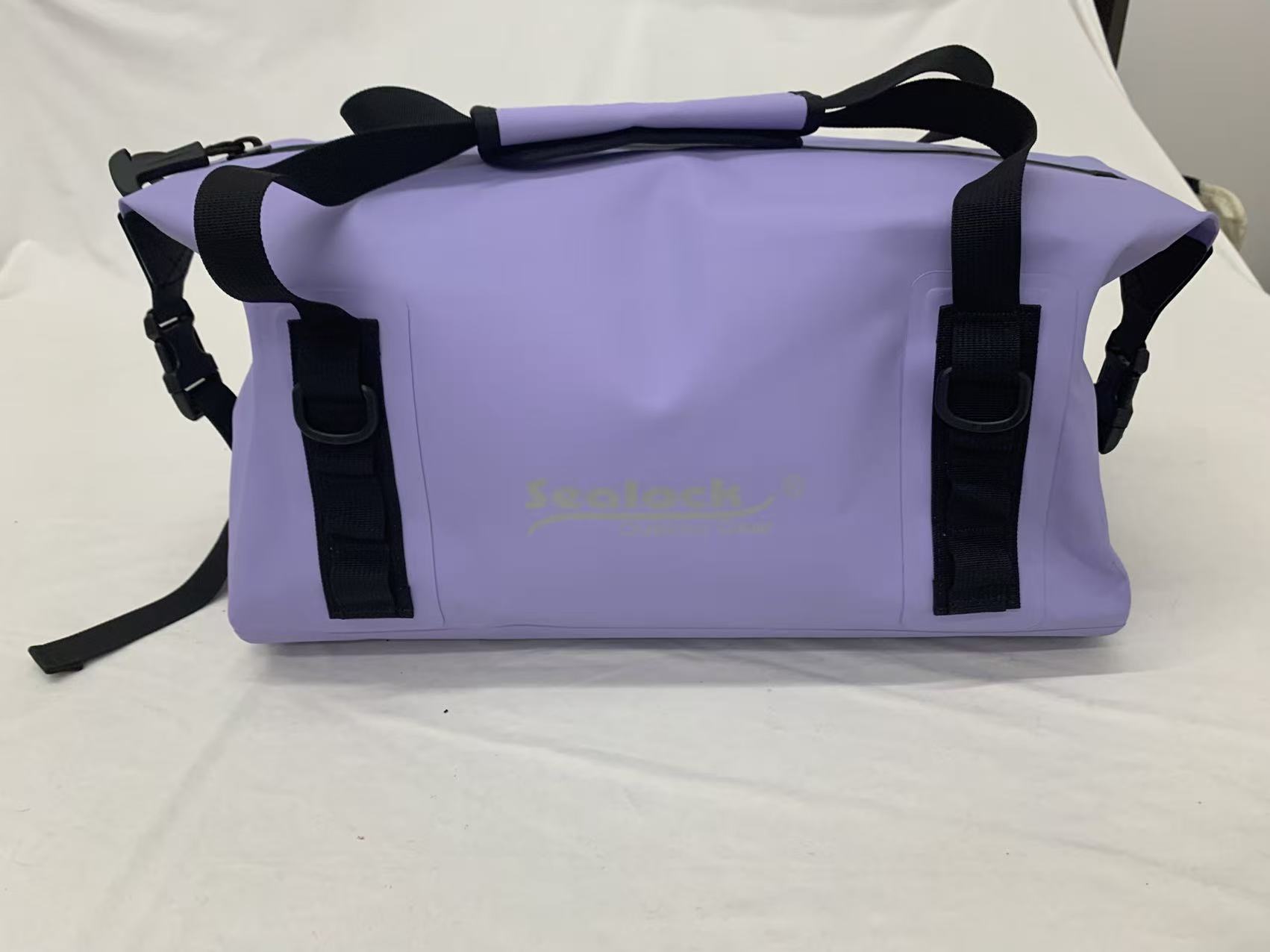
SL-C878 | 20L | 840D TPU | Airtight zipper · IPX7 · base board | View |
|
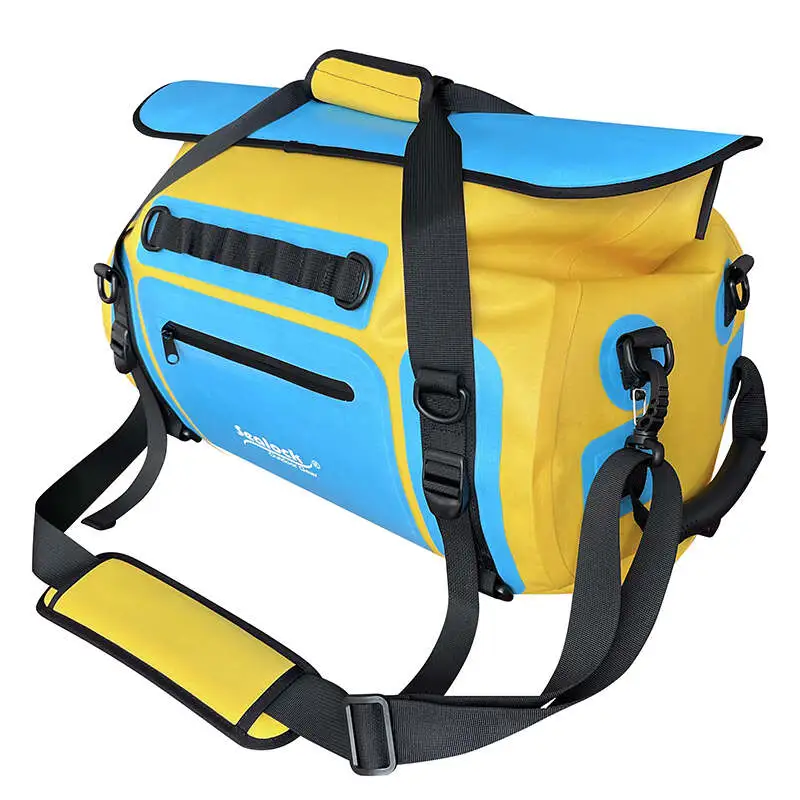
SL-C261 | 30L | TPU composite | IPX8 zipper · foldable | View |
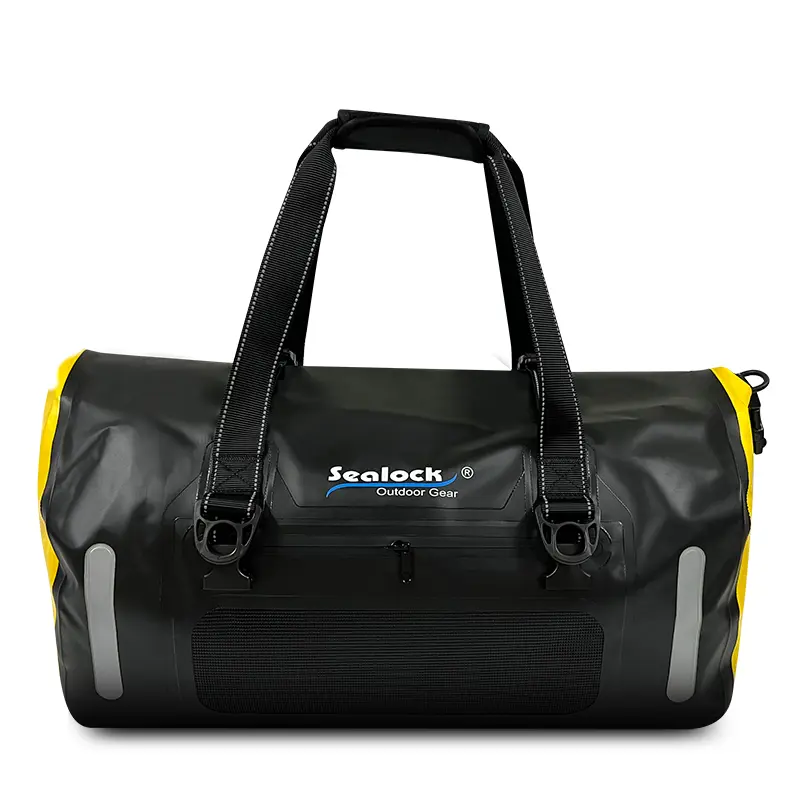
|
SL-K099 | 40 / 60L | 840D TPU | Roll-top · IPX7 | View |
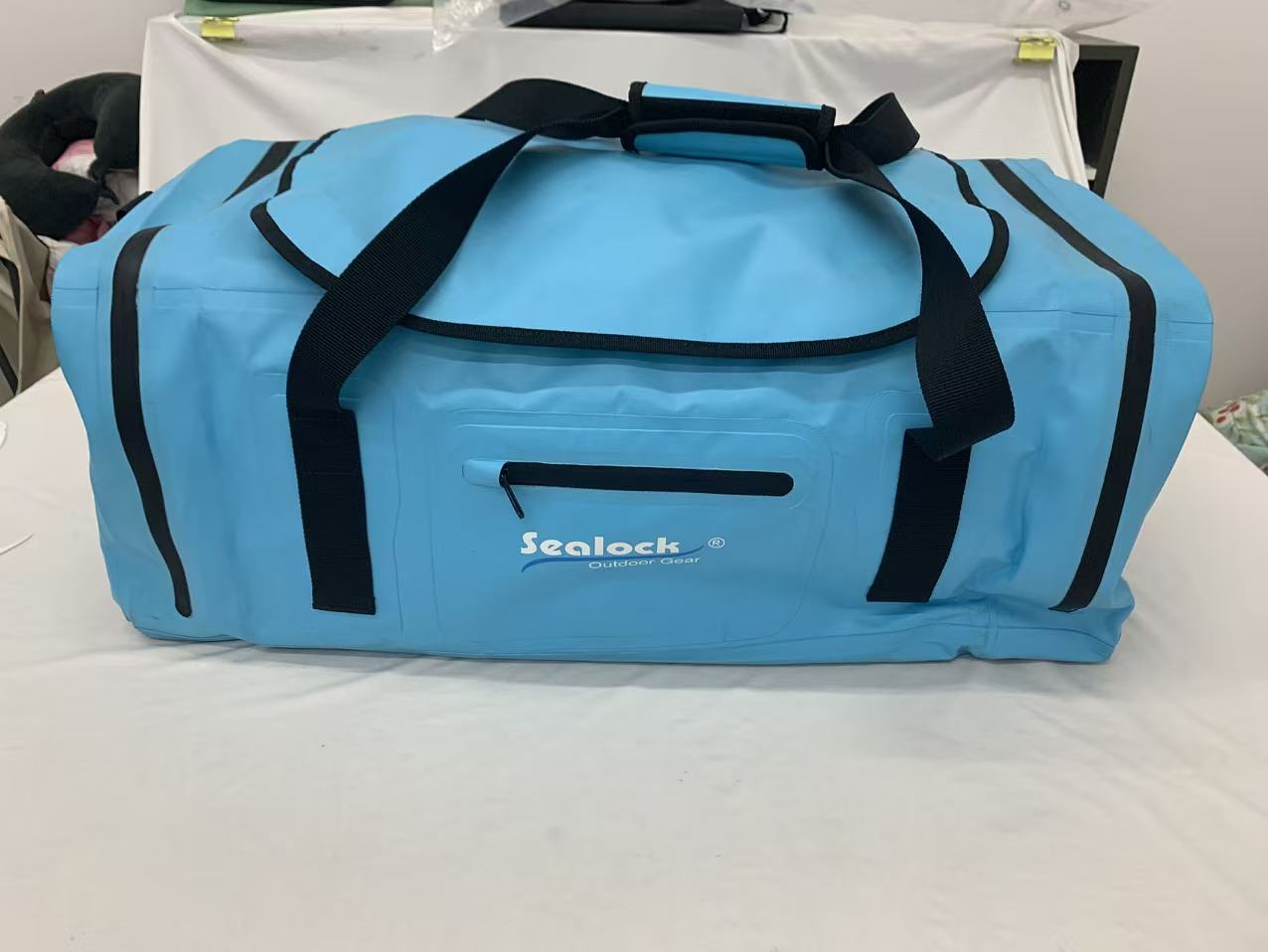
|
SL-C594 | 55L | 500D PVC (TPU option) | Airtight zipper · IPX7 · two sealed end compartments | View |
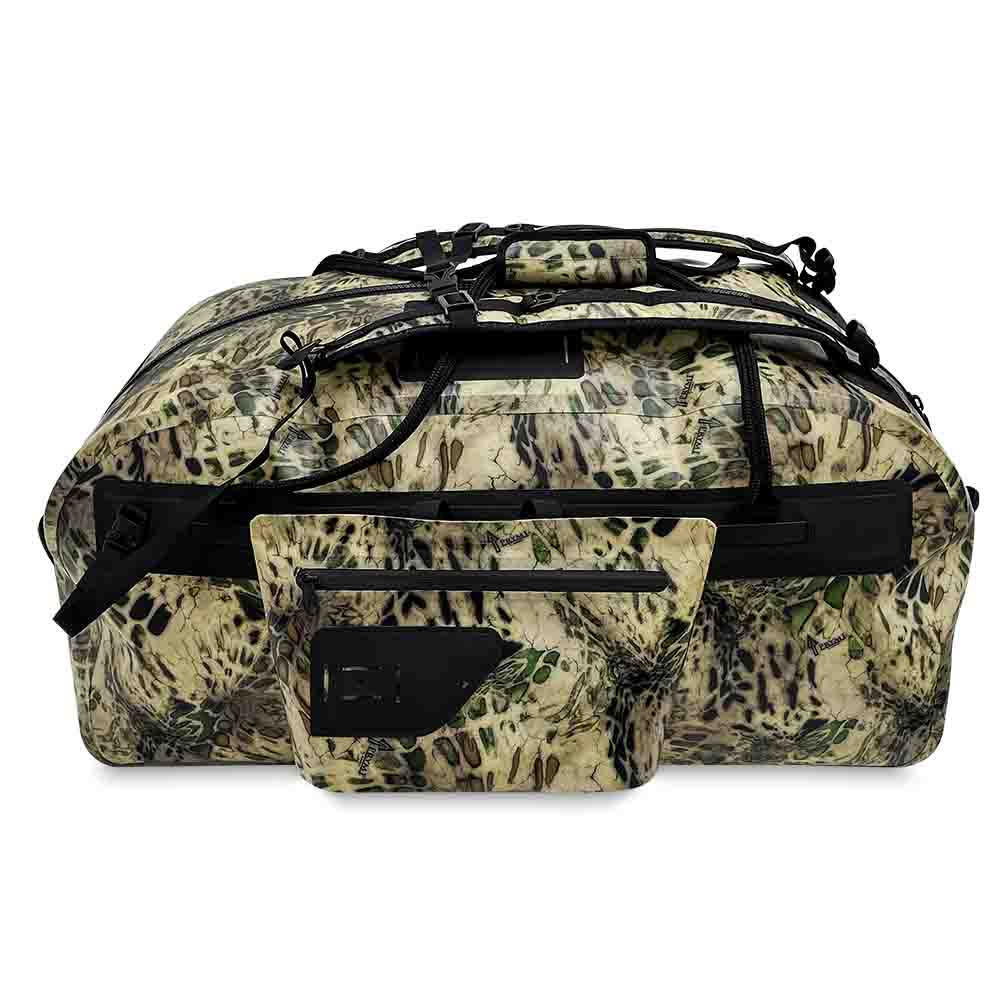
|
SL-C893 | 70L | Printed TPU laminate | Coated zipper · IPX6 · welded MOLLE, detachable pouch | View |
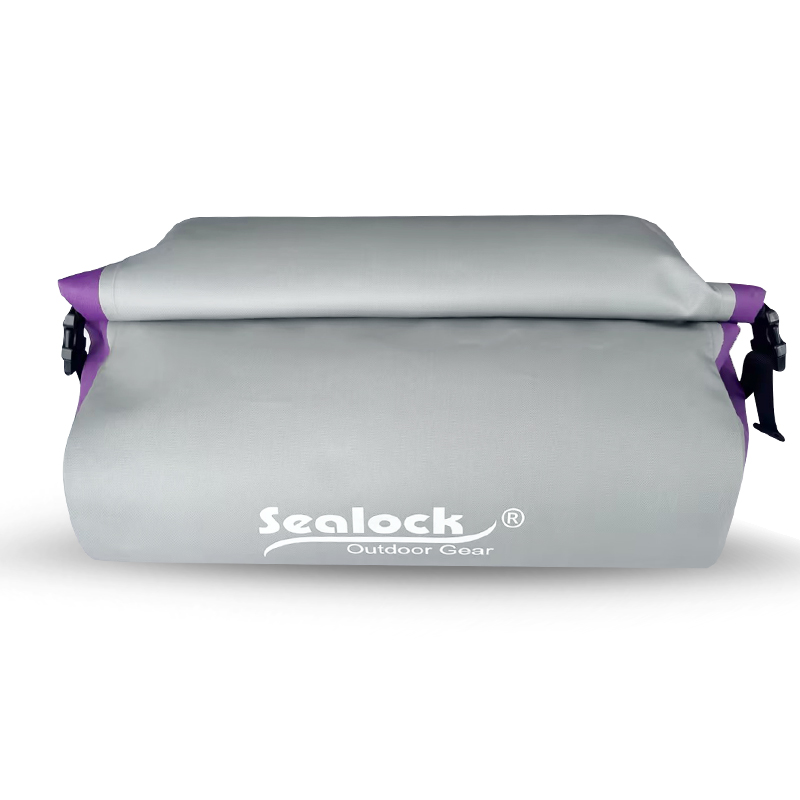
|
SL-C689 | 25L | TPU (HF welded) | Roll-top / zipper · backpack straps | View |
Capacity spans 20L to 70L across roll-top and airtight-zipper constructions in PVC and TPU. Full categories sit under duffels, dry bags, and dry backpacks. Material specification is covered in the factory materials guide, and capability verification in the supplier selection guide.
11. FAQ
Q: Why does a new duffel shape cost more and take longer than a colour change?
A: Because each geometry needs its own custom-machined copper die, quoted separately from unit price and built before sampling can start. Tooling is engineered for repeatability across thousands of units, not for one good sample, which is why development takes real time before testable parts exist.
Q: Can any bag design be RF welded?
A: Not any design. RF welding presses material between dies against a flat base plate, so it favours forms that decompose into flat welds. Three-dimensional dies and vacuum fixtures exist but are costly, which is why welded-bag design deliberately favours shapes that can be built with sensible tooling. Complex 3D features should be reviewed with the factory before the design is locked.
Q: Why is stitching done before welding rather than after?
A: Every needle hole is a leak path. Structural stitching for handles, strap anchors, and base reinforcement is completed on flat panels before the waterproof seal exists; anything attached to the sealed body afterwards is welded onto reinforcement patches instead of sewn through the membrane.
Q: Where do duffels leak, and why?
A: At corners, base junctions, and along the zipper track — not usually in the middle of a flat panel. Corners concentrate thick multi-layer junctions, the base carries the load, and a zipper track that is not parallel to the body axis puts uneven tension across the teeth when loaded.
Q: We changed colour and welds started failing — why?
A: Pigments and fillers change how the material absorbs RF energy, as do plasticizer content, moisture, and thickness. Welding parameters are qualified per material and lot, and peel tests should be run at the start of every batch rather than carrying settings over on the assumption that "same fabric" means "same process".
Q: What separates a good sample from a good production run?
A: Upstream control. Samples are built slowly by senior technicians; bulk runs at speed with more variables. Fabric lot and shade control, locked component specs, version control against the approved sample, and in-line correction are what keep the thousandth bag matching the first.
Request a Process Walkthrough
For tooling quotations, a video walk of the welding line, weld test data, or an OEM proposal, submit an inquiry. Sealock responds to procurement enquiries within 24 hours, with production from Dongguan, China or Ho Chi Minh City, Vietnam.